When "Touching Base" Hits Hard
It’s not just about misunderstanding the idiom. It’s about the devastating cost of committing 100% to the wrong instruction.

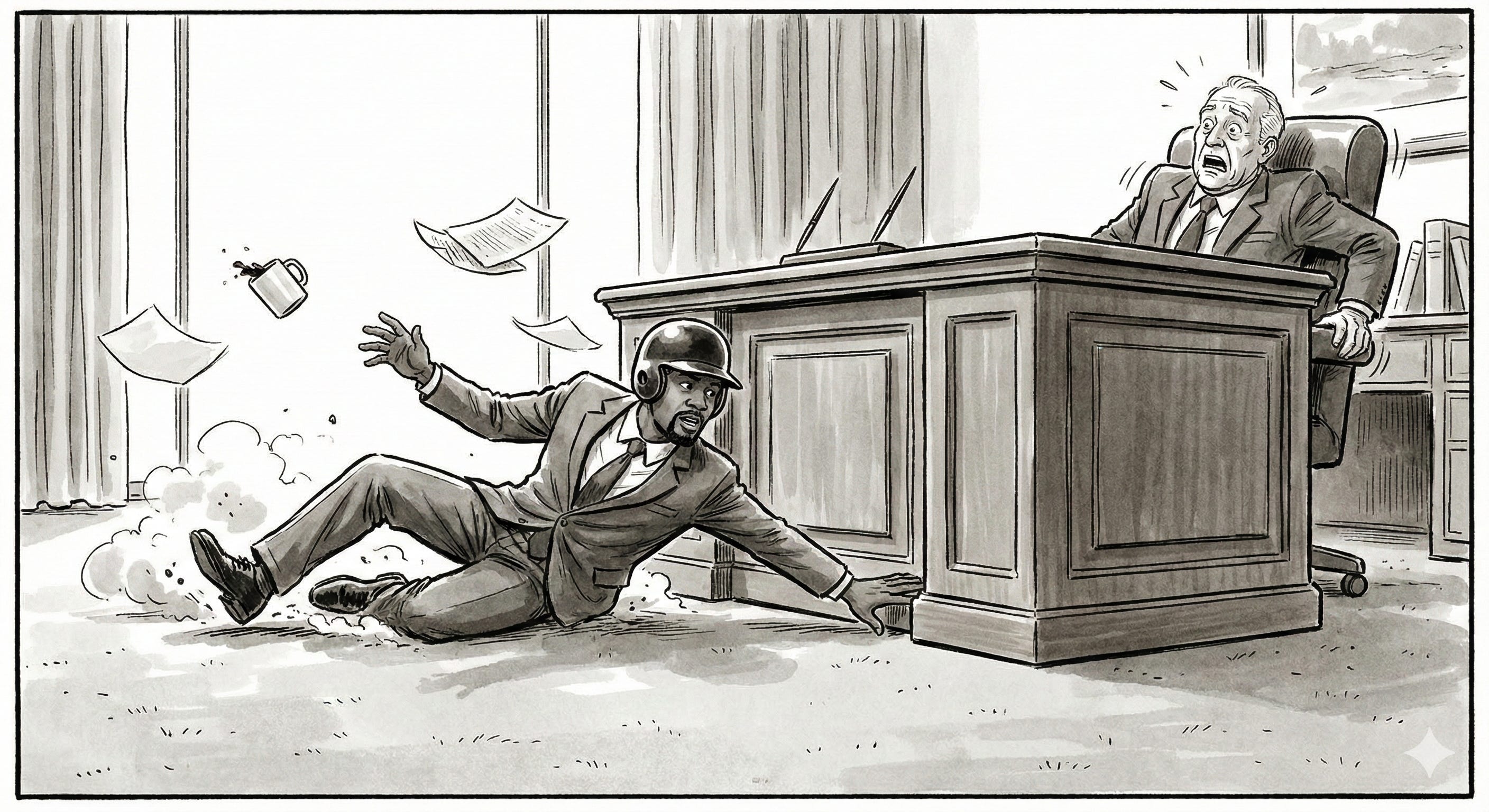
In the corporate world, I’ve come to learn that the phrase “touch base” is a throwaway phrase. It’s filler. It means a quick conversation, a status check, a five-minute sync. But this image tells a different story.
He didn’t just walk into the office. He slid. He put his body on the line. He treated the instruction with the urgency and physicality of a game-winning play. And now, he is sprawled on the carpet, physically hurt, looking up at a supervisor whose face says only one thing: “What is wrong with you?”
For me, as an Autistic professional, particularly a Black Autistic professional, this isn’t just a funny cartoon. It is a portrait of a specific type of trauma.
The Mechanics of the Slide
Once again, we are dealing with Bottom-Up Processing and Literal Thinking.
When a neurotypical brain hears “touch base,” top-down processing filters the phrase through social context and discards the baseball imagery immediately. It grabs the intent (talk) and ignores the words (sport).
My brain honors the words.
Touch: Physical contact.
Base: A safe haven to be reached, often with speed.
When I hear an instruction, I don’t half-listen. I commit. If you tell me to “hit the ground running,” I am lacing up my shoes. If you tell me to “touch base,” I am looking for the bag. The tragedy isn’t that we don’t understand metaphors eventually; it’s that our initial, primary processing creates a reality where we are prepared to execute the literal command with maximum effort.
We slide because we want to do a good job. We slide because we respect your direction.
The Moment of Impact
But I want to focus on what happens after the slide.
Look at the man’s face. He isn’t smiling. He is hurt. There is physical pain there. But the physical pain is nothing compared to the emotional damage happening in that exact second.
This is the part of the Autistic experience people rarely discuss: The realization of error.
It’s that split second where the dust settles, and you realize you have misread the room entirely. You thought you were being a dedicated employee (”I am touching base!”), but instead, you have become a spectacle. You have become a joke.
For me, a Black man in corporate America, this is catastrophic. I was raised with the “twice as good” doctrine. I know that my professionalism is constantly under surveillance. I cannot afford to be the “clown.” I cannot afford to look unhinged.
So when I “slide”—when I make a social error based on a literal interpretation—it doesn’t just feel like a mistake. It feels like I have confirmed the worst suspicions about me. It feels like safety is gone.
The Boss’s Face and the Ruminating Mind
Now, look at the boss.
That expression of shock, horror, and confusion is the stuff of nightmares. And I guarantee you, the man on the floor will see that face every night for the next ten years.
This is the Rumination Tax.
Neurotypical people can often laugh off a misunderstanding. “Oops, silly me, I took that literally.” And they move on.
For us, that moment of shock gets recorded in 4K resolution. We replay it. We analyze it. Why did I do that? Why didn’t I pause? Why is my brain like this? We replay the sound of the coffee cup falling. We replay the silence in the room.
We ruminate because we are trying to solve the puzzle, so we never get hurt again. We dissect the interaction to find the logic we missed. But there is no logic to find, only the arbitrary nature of corporate idioms.
The Hidden Cost of “Checking In”
This image is funny to some, but to me, it depicts a scene of profound vulnerability. The man in the helmet was trying to be safe (literally, “safe” on base). Instead, he ended up more exposed than ever.
This is why so many of us are exhausted. We are tired of the physical and emotional bruises we get from trying to navigate a language that is constantly setting traps for us. We are tired of sliding into desks when everyone else is just walking to chairs.
So, when you ask us to “touch base,” or “knock it out of the park,” or “step up to the plate,” remember who you are talking to.
We aren’t just listening. We are preparing to play. And we play hard.
Don’t let us hurt ourselves trying to follow your rules.
I find myself constantly trying to explain my intent because I genuinely don't know how to be helpful in a way that makes other people feel comfortable. Sharing resources is seen as "trying to control everything" and attempting to reduce others' workload by providing foundation from the "before" is seen as resistant to change. Then, to avoid being misunderstood, I stop talking, then I'm not a team player. Exhausting.